
Case study
Hivelink — From zero to 1,000 users in 3 months
Real-time urban mobility platform — passenger app, operator back-office, and backend
See the live product- Client
- Hivelink Group — French urban mobility startup
- Role
- Sole full-stack developer — architecture, product, development, deployment
- Timeline
- Empty repo in November 2025 · public launch in May 2026 · 1,000 sign-ups in August 2026
- Stack
- React 19 · TypeScript · Vite · Flask/Python · Firebase · Socket.IO · Leaflet/CARTO · GTFS-RT · Docker · Google Cloud Run
The context
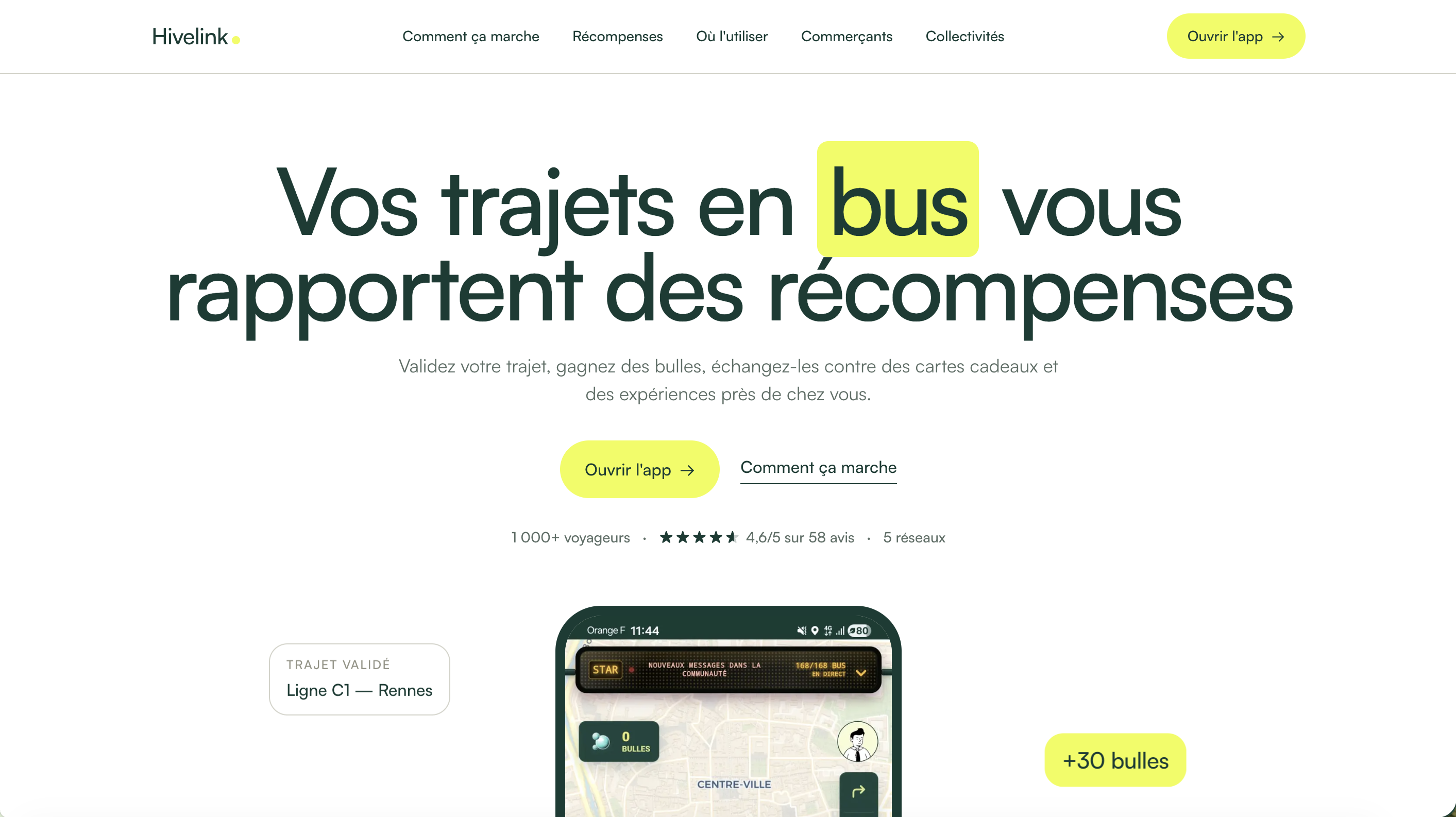
Hivelink wanted to turn a bus ride into an experience that makes you want to take public transport again: know where your bus is in real time, report an issue, earn rewards, connect with fellow riders. On the operator side, they needed a console to manage it all: incidents, communications, satisfaction analytics.
At the start, nothing existed. No code, no design system, no infrastructure.
The key constraint
The product had to work without depending on a commercial agreement with a transit operator. I designed the platform around open GTFS and GTFS-RT data published by networks: the app is live in four cities — Rennes (STAR), Bordeaux (TBM), Amiens (AMETIS), and Angers (IRIGO) — and adding a new network is done from the back-office via GTFS import, with no development work required.
This architectural choice made it possible to launch fast, across multiple cities at once, with zero commercial friction.
Cities are covered via their open GTFS data, with no commercial partnership with operators.
What I built
Two applications connected to a real-time backend, developed solo.
The passenger app
Real-time vehicle map powered by GTFS-RT feeds, active trip tracking with next stop and estimated arrival, route planner, community feed (posts, polls, comments, real-time notifications), loyalty and rewards program, gamified missions and leaderboards, sponsored events with partner validation, trip rating and SOS button. All behind a 6-step onboarding with explicit GDPR consent.
The operator back-office
Activity dashboard, incident mapping and report heatmap, satisfaction analysis by category, feed moderation, targeted communication campaigns, multi-network management with GTFS import, trip validation tracking, batch and reward management.
The foundations
Custom design system (21 component families, tokens, stories), shared real-time WebSocket layer across both apps, Firebase authentication, Sentry monitoring, internationalization, and GitHub Actions CI/CD pipeline to Google Cloud Run with separate staging and production environments.
Results
- 1,000+ sign-ups in 3 months, with no acquisition budget
- 4.6/5 average rating from 76 reviews — the product doesn't just attract, it satisfies
- 4 transit networks covered in the first year, with no operator partnership required
- New network addable from the back-office via GTFS import, with no development intervention
- Platform in production, continuously deployed and enriched every week since launch
- 450 of 472 project commits (95%) — architecture, product, and code owned by one person
- ~41,500 lines of code delivered from an empty repo
- 2 apps + backend in production, staging and production CI/CD on Google Cloud Run
- Full design system built from scratch: 21 component families, 226 React files
Have a similar project in mind?
Let's talk about your idea — from architecture to deployment.